Split Keyboards
A split keyboard has two separate halves that you can place and angle on their own. Boards are listed here when that is the point of the board, not just an angled layout in one case.
Halves may be joined by a cable or left wireless, and layouts range from a familiar 75% split in two to smaller ergonomic boards with fewer keys.
If you only want one, start with ZSA Voyager . It is a low-profile 52-key split with hot-swap Choc switches and published firmware.
About split keyboards
A split keyboard puts the keys on two separate halves, so you can set each one at shoulder width and angle it to suit your wrists. That is different from an Alice board, which angles the keys inside one case. Here, the halves come apart. Most are joined by a cable or link wirelessly; a few add tenting kits, wrist rests, or thumb clusters. They suit people who type all day and want their arms open, not pulled in toward a straight board.
This page lists 14 split keyboards, from $99 to $1,050. Some keep a familiar 75% layout, like the Keychron Q11; others cut the key count down and move modifiers to the thumbs, like the ZSA Voyager at 52 keys. Some are wired only, and some link the halves wirelessly. Each card below links to a board page with specs, prices, and sources. Every page is researched from maker specs and published sources, not hands-on testing.
14 keyboards
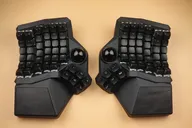
“An off-the-shelf curved-keywell split with dual 34 mm trackballs and hot-swap MX switches”
The off-the-shelf version of Cyboard's Imprint: 82 keys with a thumb cluster, dual trackballs, continuous tenting to about 45 degrees and hot-swap MX switches. Choose Premium or Standard trim and wireless (ZMK) or wired-only (QMK-Vial).

“A fully split columnar board with an aluminum plate; wireless, tenting and underglow are paid add-ons”
A fully split columnar keyboard with 62 MX hot-swap sockets plus 8 Choc thumb keys, per-key RGBW and an anodized aluminum plate. The USD 369 base is wired; wireless, tenting and underglow are add-ons up to USD 619.
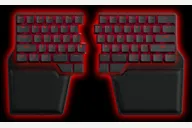
“A 60%-style split with thumb keys; wireless, tenting and underglow are paid add-ons”
A split built on a 60% layout with 64 MX hot-swap sockets plus 4 Choc thumb keys, per-key RGB and a brushed aluminum plate. The USD 369 base is wired; wireless, tenting and underglow are add-ons up to USD 619.
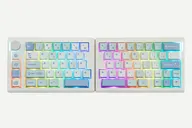
“An affordable 70% split with tri-mode wireless, gasket mount and a knob”
A 71-key split on a 70% layout with Bluetooth, 2.4 GHz and wired modes, gasket mount, hot-swap Wisteria Linear V2 switches, a knob and VIA support. Reviewers note a tiny right Shift, a shifted right number row, no adjustable feet and short RGB battery life.
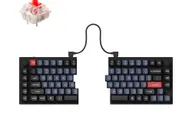
“Split 75% aluminum Q with a knob on each half”
A fully split wired 75% aluminum Q with two knobs, five macro keys and a tray-mount case, about 1.2 kg. Reviewers like the build and customization; no tenting kit.
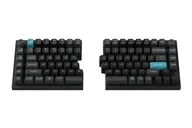
“A cable-free 75% split in aluminum with 8000 Hz polling and Silk POM switches”
A gasket-mount, all-aluminum 75% split whose halves sync over 2.4 GHz with no cable between them. It adds Bluetooth, wired USB, hot-swap Silk POM switches, a knob and ZMK firmware. Reviewers note no tenting and some buyers report right-half dropouts.
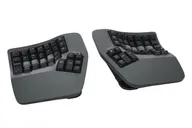
“Kinesis' contoured key-well split with tenting, in wired SmartSet and wireless Professional versions”
A 76-key split with concave key wells, integrated 3-way tenting and a thumb cluster. SmartSet is USB-C wired; Professional adds Bluetooth, ZMK and Clique programming. Reviewers praise comfort and build and flag the steep learning curve and soldered switches.
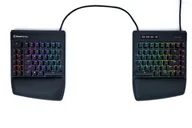
“A wired, hot-swap split with per-key RGB, palm supports and the Lift Kit included”
A wired, split mechanical keyboard with hot-swap Gateron switches, per-key RGB and onboard SmartSet programming. The Plus model includes the Lift Kit tenting accessory and palm supports; PC Gamer notes no wireless.
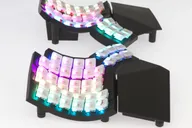
“A wireless, concave split with a 6-key thumb cluster and continuous tenting”
An 80-key wireless split with concave key wells, Kailh Choc v1 switches, built-in continuously adjustable tenting and ZMK firmware. PC Gamer calls it astonishingly adjustable, with a tough adaptation period and a high price.
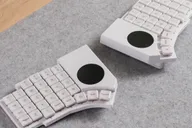
“A compact 60-key travel split with dual touchpads, hot-swap Choc switches and a case”
A 60-key columnar split with two 40 mm touchpads, hot-swap Choc v1 switches, magnetic 6-step tenting and a travel case. It connects by Bluetooth LE or USB and switches to a wired TRRS link when plugged in; ZMK firmware.
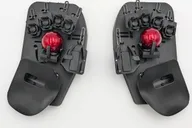
“A Datahand-style split with 20 gf magneto-optical keys and optional integrated pointing”
A Datahand-inspired split with finger and thumb clusters, 20 gram-force magneto-optical key mechanisms, adjustable fitment for each digit and optional trackball, touchpad or trackpoint. Wired USB-C, Vial-QMK firmware, built to order in the USA.
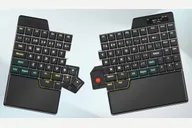
“A wireless 80% split with a thumb cluster, OLED display, palm rests and hot-swap sockets”
A wireless split on an 80% tenkeyless layout with an eight-key thumb cluster, a 2.08 inch OLED, an integrated wooden palm rest and hot-swap sockets. Connects by USB-C, Bluetooth LE or a separate dongle; batteries are optional. GBAtemp praises wireless and battery life without LEDs.
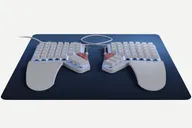
“ZSA's modular, hot-swap split with a tilting thumb cluster and tenting accessory”
A wired, hot-swap MX-style split with RGB, QMK firmware, a tilting thumb cluster and wrist rests. Tom's Guide praises the customization and typing feel and says it has a steep learning curve; PC Gamer notes no wireless option.
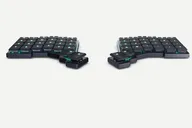
“A 52-key, low-profile split with magnetic tenting legs and a travel case”
A wired, hot-swap, 52-key split board with Kailh Choc low-profile switches, per-key RGB and QMK firmware. ZSA ships it with magnetic tenting legs and a carrying case; reviewers flag the missing wireless and the layer-heavy layout.
Frequently asked questions
What is a split keyboard?
A split keyboard has two physically separate halves instead of one block. You can place each half where your hands naturally fall, usually about shoulder width apart, and many boards let you angle or tent them. The aim is a straighter wrist and a more open shoulder position than a single straight board allows. Whether that helps you is personal; this page lists what exists and what the makers say it does.
What is the difference between a split keyboard and an Alice layout?
An Alice keyboard splits and angles the alphanumeric keys inside a single case, so it stays one piece. A split keyboard has two halves that you can move apart. If you want to try an angled layout without changing your desk setup, start with the Alice boards. If you want to place each hand independently, you want a split.
Are split keyboards wireless?
Some are, some are not. The ZSA Moonlander and Voyager connect to a computer over USB-C, and their halves are joined by a cable. The Keychron Q11 is wired. The Keychron Q11 Ultra 8K adds 2.4 GHz and Bluetooth, and syncs its halves wirelessly. Other boards, such as the MoErgo Glove80 and the Professional version of the Kinesis Advantage360 (the SmartSet version is wired), list Bluetooth. Check the connectivity line on each board page; it varies even inside one maker's range.
How much do split keyboards cost?
On this page they run from $99 to $1,050. At the low end, the Epomaker Split70 lists at $99–$116. In the middle, the Keychron Q11 is $205 and the ZSA Voyager is $365. At the top, the Svalboard Lightly runs $800–$1,050, and it is not a conventional key layout. Prices are as of 15 Nov 2026 and can change; check the board page for the latest figure we have.
Is there a learning curve?
Usually, yes, and it depends on the layout more than on the split itself. A board like the Keychron Q11 keeps a 75% layout with a function row and arrow keys, so the main change is where your hands sit. Boards with fewer keys, such as the ZSA Voyager's 52 keys, ask you to use layers for things a standard keyboard has on dedicated keys. If you are unsure, pick the one that keeps the layout you already know and reduce keys later.
To practice on a new split, see our typing tools list.
Do these use hot-swap or low-profile switches?
Several do. The ZSA Voyager uses low-profile Kailh Choc switches, and ZSA says they are hot-swappable. The Keychron Q11 is hot-swap with MX-style sockets. The Glove80 is built around low-profile Choc switches. Compatibility differs by board: Choc switches do not fit MX sockets, and the reverse is true too. Check the switch line on each board page before buying replacements.
Are DIY split kits listed here?
Only where the maker publishes a price in US dollars that we could check. Kits mean you source switches, keycaps, and sometimes a controller and case; they cost less up front and take more time. Popular open-source designs such as the Corne, Lily58, and Sofle are sold by several shops, mostly as PCB or parts kits, so a price depends on what is in the box. We add a kit only when one maker's complete listing is clear enough to describe accurately.
Which split keyboard should I open first?
If you want a finished board with a large community and published firmware, look at the ZSA Voyager or Moonlander. If you want a split that still looks like a normal 75% board, look at the Keychron Q11. If you want to spend as little as possible, the Epomaker Split70 is the cheapest we list. These are starting points from researched sources, not hands-on tests.