Keychron
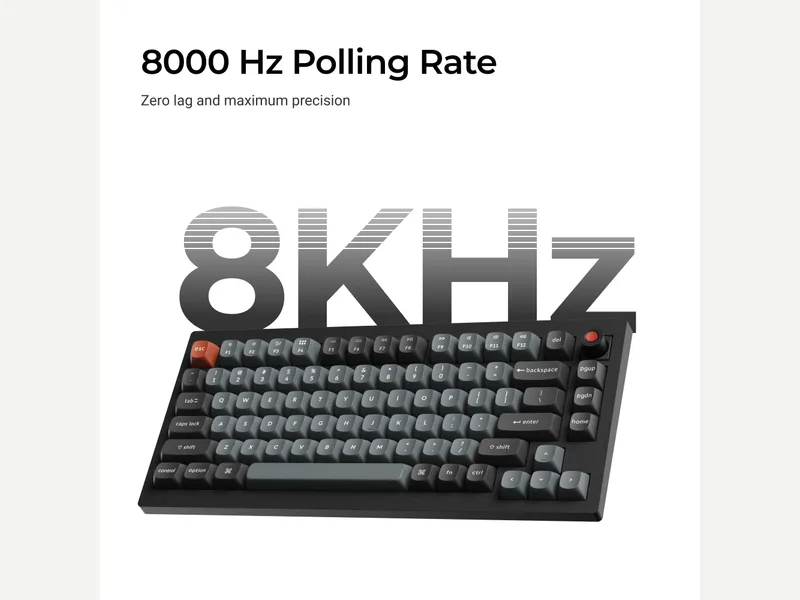
Keychron V1 8K
Released 2026
Researched from maker specs and published sources. Last checked Oct 18, 2026.
Wired 75% with 8000Hz polling and a gasket mount
A wired V1 refresh with Keychron Super switches, a gasket mount, PC plate and 8000Hz polling. Tom's Guide praised the build and sound; some body flex and no wireless are the trade-offs.
Sources
Our take, based on research
A sensible refresh of the wired V1: the same 75% layout with a gasket mount, a PC plate and 8000Hz polling. Tom's Guide rated it highly for build and sound, with flex and no wireless as the drawbacks. If you want wireless, the V1 Max is the better fit.
Overview
The V1 8K keeps the V1's wired 75% layout and knob but changes the build. Keychron's spec page lists a plastic case with a gasket mount and a PC plate (the original V1 used a tray mount and steel plate), Keychron Super hot-swap switches, OSA double-shot PBT keycaps, an 8000Hz polling rate and QMK with the Launcher web app. Keychron lists 995 g and 147.7 x 328.05 mm.
Tom's Guide reviewed it in May 2026 as a follow-up to its earlier V1 review. It found the all-ABS body well built and not hollow when tapped, called the gasket mount cushioned, and said Keychron cut the foam layers from three in the original V1 to two here. With the Banana tactile switches (57 g actuation, 2 mm pre-travel, 3.4 mm total travel, per the review) it heard a satisfying, a little clacky but slightly thocky sound, and it typed seven hours straight without discomfort. Its 10fastfingers result was 99WPM at 95.03% accuracy. It listed the V1 8K at 2.19 lb, against 2.13 lb for the V1, and said it carried it in a backpack without trouble. Its two complaints were some flex in the body and the lack of a wireless variant.
Tom's Guide also pointed out that most players will not notice the difference between 8000Hz and 1000Hz polling, and that 8KHz can use more system resources. The practical case for this board is the newer gasket build on a wired layout, with 8000Hz as a bonus rather than the main reason.
Pros & Cons
- Gasket mount with a PC plate gives a cushioned feel (Keychron's spec page; Tom's Guide)
- 8000Hz polling rate
- QMK firmware and Launcher remapping, per-key and mix RGB (Tom's Guide), plus a metal knob
- Hot-swap sockets for Keychron Super switches or other 3-pin and 5-pin switches
- Double-shot PBT keycaps with Mac and Windows legends
- Tom's Guide described a satisfying, slightly thocky sound and a solid, non-hollow plastic body
- 2.19 lb (Tom's Guide), light enough that the reviewer carried it in a backpack
- Wired only; there is no wireless version (Tom's Guide)
- Some flex in the body (Tom's Guide)
- 8000Hz brings little benefit over 1000Hz for most players and can tax system resources (Tom's Guide)
- Fewer foam layers than the original V1 (Tom's Guide)
- Plastic case, so it will not feel as dense as Keychron's aluminum boards
Who Is This For?
- Wired typists who want the newer gasket build of the V1 layout
- Gamers who want 8000Hz on a compact board
- QMK users who prefer to remap through a web app
- Anyone who wants wireless
- Buyers who dislike body flex
- People who only want standard 1000Hz and are happy with the cheaper V1
Where to Buy
Dimensions
147.7 x 328.05 mm
Weight
995 g ± 10 g
Case Material
Plastic
Connectivity
Wired
Plate Options
Case Colors
Software Support
Similar Keyboards
View all
Looking for something different?
Browse All Keyboards